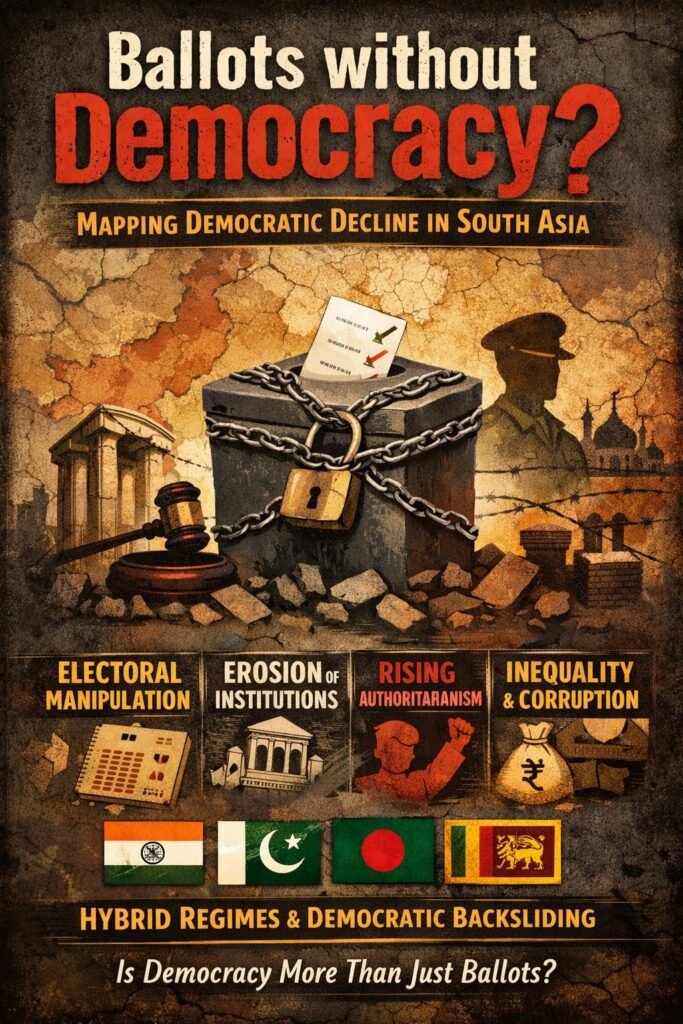
Ballots without Democracy? Mapping Democratic Decline in South Asia

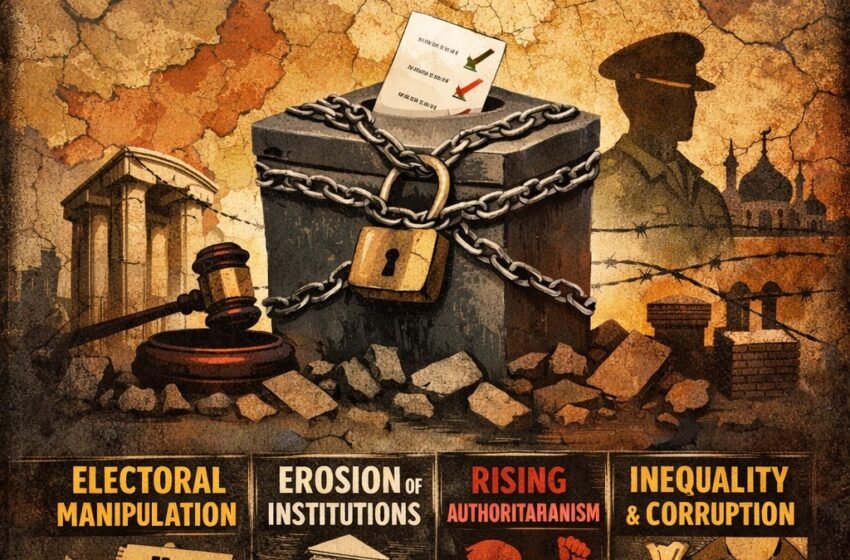
Democracy has long been regarded as the best form of governance, founded on popular sovereignty, political equality, and institutional accountability. However, is it truly the best? Does democracy ensure happiness for all citizens, or does it guarantee equal opportunities, equal rights, equal wealth distribution, and equal justice? Should we stop thinking beyond democracy, or is it limited merely to voting day? Challenging Francis Fukuyama’s notion of the “end of history,” democracy in twenty-first-century South Asia is undergoing a profound crisis. Elections are held regularly, yet the soul of democracy—independent institutions, a strong opposition, the rule of law, and equal competitive opportunities—is steadily weakening.
This research paper maps the crisis in South Asian democracies through the theoretical frameworks of democratic backsliding and elected authoritarianism. Democracy is often reduced to mere ballots, whereas true democracy lies in institutional balance, political pluralism, and civil liberties. Elected governments undermine constitutional institutions to consolidate power. In India, alongside electoral competition, there is increasing pressure on institutional autonomy and opposition space, with election-conducting bodies becoming “toothless tigers,” and the exorbitant cost of elections (making it unimaginable for the common person to contest) highlighting inequalities in the level playing field. In Pakistan, a hybrid regime prevails, where army chief Asim Munir wields real power in the name of democracy. Bangladesh faces serious questions about the credibility of electoral processes, while Sri Lanka’s institutional failures were exposed during its economic crisis. Historically, in South India, practices like booth-capturing and filling ballots at home illustrate weaknesses in electoral fairness.
The study also sheds light on the political economy of democracy—despite the electoral participation of the poor and marginalized, policy-making remains dominated by economic elites. In democracy, people are counted, not weighed; earlier, votes were sought for a strong opposition, knowing victory was unlikely, but today everyone claims victory. Governments come to power on the votes of the poor, then take donations from the rich to enact laws in their favor, leaving little democratic space or level playing field for the opposition. After all, India has been the cradle of democracy.
From a comparative perspective, democracy in South Asia is neither permanent nor irreversible; it must be sustained as a continuous, participatory, institutionally robust process, else the gap between ballots and real governance widens.